Asian American
Institute for
Public Policy
A nonprofit public policy organization
dedicated to advancing equality and
full participation for Asian Americans
Immigration
A recent POLITICO poll conducted April 11th – 14th found that 51 percent of Americans think President Trump’s immigration agenda is “too aggressive”, with 26 percent saying they think his immigration agenda is “about right” and 11 percent saying it’s “not aggressive enough.”
Among Asian adults, 60 percent indicating that it is “too aggressive”, with 28 percent indicating “about right” and 6 percent “not aggressive enough”.
The Trump Presidency
Based on the RealClear Politics average of recent polls (6/18-7/16), President Donald Trump’s current job approval rating stands at 55.6% disapprove to 41.1% approve.
Three national polls, Washington Post / Ipsos, Harvard CAPS – Harris, and Quantus Insights, show that a majority of U.S. adults/voters disapprove of President Trump’s job performance by 61%, 54% and 55% respectively.
2026 Midterm Elections
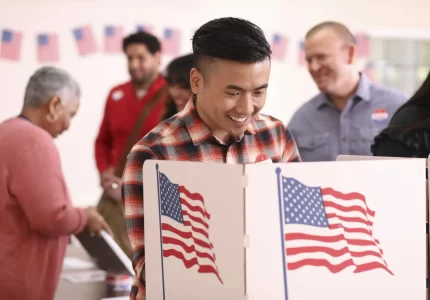
When asked whether they would vote for the Democratic candidate or the Republican candidate if the mid-term congressional elections were being held today, all likely voters in a July 2026 Quantus Insights national survey favor the Democratic candidate slightly more than the Republican candidate in their congressional district, 47% to 42%.
Asian likely voters would vote for the Democratic candidate in a bigger margin, 56% to 28%.

Immigration is driving the nation’s modest post-pandemic population growth, new census data shows.


AAIPP’s policy interests cover several broad areas - Select published opinion writings on key policy matters are welcome for the purpose of informing and encouraging thoughtful policy discussions.
AAIPP Bulletin

Published eleven times a year, this data - driven newsletter covers the latest of certain pressing national policy issues and their implications to Asian Americans.
State of Chinese Americans Survey:
Beyond the Party Line: Chinese American Partisanship and Vote Choice
Committee of 100 & NORC at the University of Chicago (September 10, 2026)
2026 AAPI Voter Survey
APIAVote & AAPI Data (August 26, 2026)
How Americans Are Engaged With News, Politics, Religion and Civic Life
Pew Research Center (July 16, 2026)

Lessons from the 1996 Welfare Reform Law Approaching Its 30th Anniversary
Matt Weidinger
American Enterprise Institute (July 24, 2026)
As childcare costs skyrocket, states need a new approach to help working families
Brookings Institution (July 2, 2026)
Reducing Poverty Among Older Adults
Brookings Institution (June 17, 2026)

Educational Attainment in the United States: 2024
U.S. Census Bureau (September 3, 2025)
More Students Than Ever Learning Asian American History as 23 States Adhere to Asian American History Requirements
Committee of 100 (August 28, 2025)
Racial Attitudes Among Asian American Parents and Their Influence on School Choice
Tiffany Wu, Adriana Villavicencio, Verenisse Ponce Soria
Harvard Educational Review (December 10, 2024)

One Year In: Public Views of A Changing Public Health Landscape
De Beaumont Foundation / Harvard T.H. Chan School of Public Health (June 9, 2026)
AAPI adults have more confidence and trust in medical professionals like doctors and scientists than government officials, and most are stressed about health concerns
AAPI Data/AP-NORC (May 4, 2026)
Emerging Trends in Texas ACA Marketplace Enrollment for 2026
Shao-Chee Sim & Elena M. Marks
Baker Institute for Public Policy, Rice University (April 29, 2026)
Immigrant Public Benefit Participation
Brookings Institution (July 24, 2026)
Birthright Citizenship in the United States
American Immigration Council (July 9, 2026)
Indian Immigrants in the United States
Migration Policy Institute (April 15, 2026)
Immigrants’ Recent Effects on Government Budgets: 1994 – 2023
Cato Institute (February 3, 2026)

STAATUS Index 2026 Report: Attitudes Toward Asian Americans and Pacific Islanders
The Asian American Foundation and NORC at the University of Chicago (May 2026)
Closing Doors, Widening Harms: The State of Anti-AA/PI Hate in 2025
Stop AAPI Hate (May 2026)
AAJC Analysis of Preliminary 2025 FBI Data
Asian Americans Advancing Justice (April 17, 2026)

Breakneck: China’s Quest to Engineer the Future
Dan Wang
Norton (August 26, 2025)
China’s Sanctions Gambit: Formal and Informal Economic Coercion in the Second Trade War
Audrye Wong, Viking Bohman, and Victor Ferguson
The Swedish Institute of International Affairs (June 18, 2025)

State of AAPIs National Report
The Asian American Foundation (July 2026)
State of AAPIs New York City Report
The Asian American Foundation (July 2026)
The Newest New Yorkers
(2026 Edition)
New York City Department of Planning (June 2026)
The AANHPI Effects: Content and Fandom
Nielsen (May 7, 2026)

Support
Acknowledgement
AAIPP’s work has been generously supported by the C.J. Huang Foundation and individual donors.
Ways to Give
AAIPP welcomes general-purpose contributions as well as designated gifts for specific purposes such as a research project, a policy/research fellowship, the monthly AAIPP Bulletin, etc. All contributions are tax deductible. For further details, please contact Cao O at cao@aaipp.org
About Us
Amplify Asian American Voice & Thought Leadership
The Asian American Institute for Public Policy (AAIPP) is a nonprofit public policy organization dedicated to advancing equality and full participation for Asian Americans. It works to amplify Asian American voice and thought leadership to address community concerns and to contribute pragmatic solutions to vital social, economic, and political issues in America. Through an inclusive perspective and a balanced approach, AAIPP seeks to promote reasoned dialogue and informed policy discourse that is guided by data, empirical research and critical analysis.